

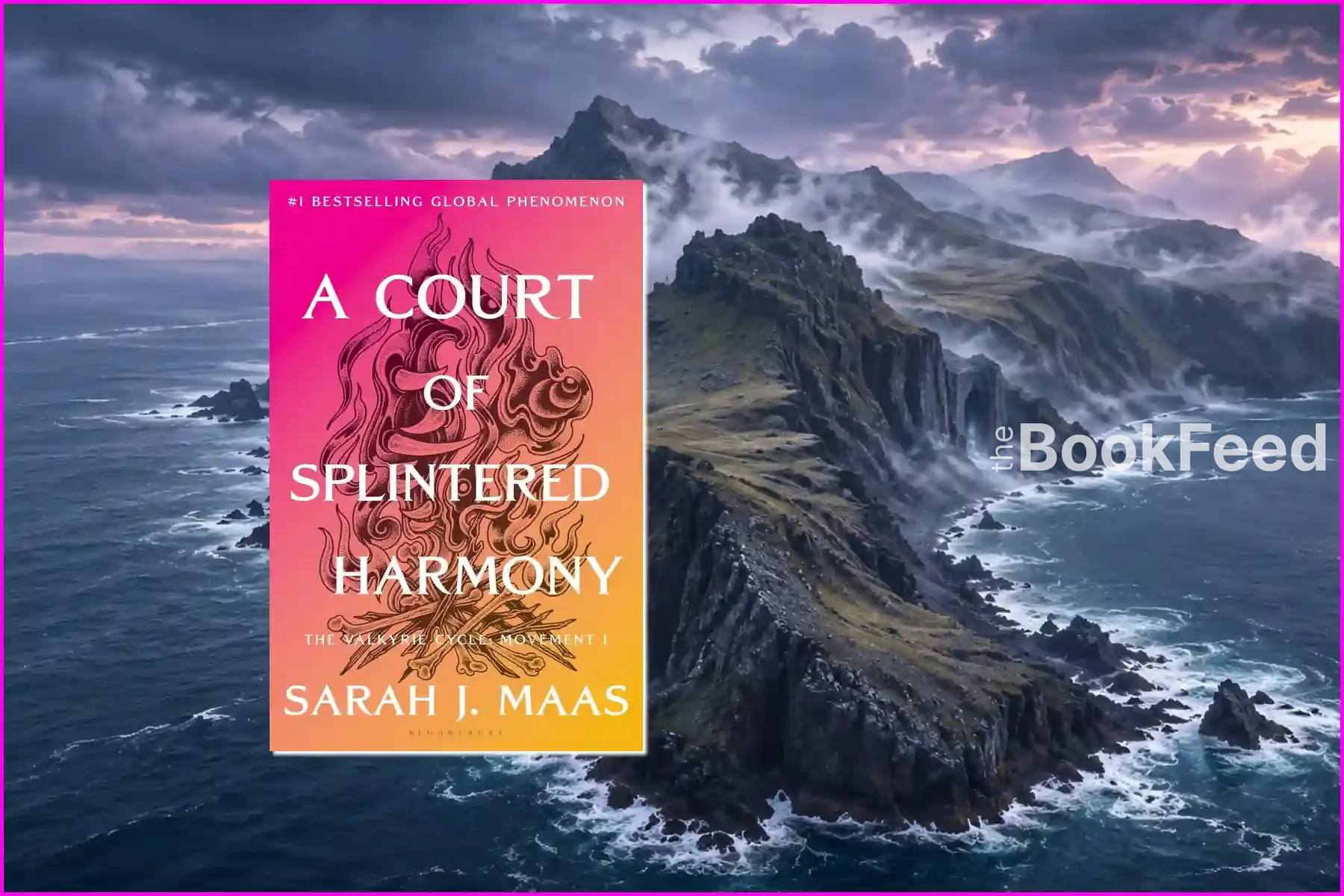
A Court of Splintered Harmony begins just four weeks after the events of House of Flame and Shadow. Nesta’s decision to lend Bryce the Mask is still dividing the Inner Circle when a growing threat from the continent demands that they work together.
This is the opening movement of the Valkyrie Cycle, a much larger, continuous story. Its ending opens the next stage of that story rather than resolving every conflict. Below, we break down the A Court of Splintered Harmony summary, ending and biggest theories, from Gwydion’s disappearance to the possibility that Koschei is helping the Night Court tear itself apart.
A Court of Splintered Harmony: The Ending in Brief
Nesta reaches the Prison with Gwydion, but the sword is taken from her hand. The book ends without revealing who or what has taken it. Meanwhile, Elain persuades Mor to take her to Vallahan after Lucien discovers her with Azriel and withdraws his cooperation with the Night Court.
The continental conflict and Koschei’s threat remain unresolved. The central cliffhanger sends Nesta into the Prison’s mysteries while Elain steps into the political conflict beyond Prythian.
Contents
A Court of Splintered Harmony Summary
Azriel Investigates a Made Weapon on the Continent
Azriel’s investigation takes him to Rothorn Peak in Montesere, where men connected to several continental kingdoms are searching for a powerful Made object. The cave is empty, but the search reveals that the kingdoms are pursuing a weapon that could change the balance of power.
At negotiations on Storr, Feyre, Rhysand and Mor face resistance from Vallahan and Montesere. The kingdoms want to reclaim human territory and resent the Night Court’s advantage in possessing the Dread Trove. The negotiations fail to secure the cooperation Prythian needs.

Azriel subsequently follows Vallahan’s royal family to Thrudheim. There, he discovers that the continental kingdoms are not united in their intentions: Vallahan wants the weapon for itself rather than sharing its power with its allies.
Nesta and Cassian Struggle With the Fallout of the Mask
The Mask has been returned, but Nesta’s decision to lend it to Bryce continues to damage her relationships. Cassian is hurt that she made such a consequential choice without involving him. Nesta stands by her decision to help Bryce and feels increasingly isolated by the court’s response.
Nesta and Cassian eventually discuss what has hurt them and reconnect. Their reconciliation does not settle Nesta’s broader uncertainty about where she belongs or what she wants to do with her power.
Nesta Tries to Reach the Prison and Senses Something Beneath the Sea
Nesta has been secretly teaching herself to winnow. She wants to return to the Prison, following the questions left by her encounter with Bryce: the island’s history, Gwydion and the eight-pointed star on her back.

Her attempt leaves her in the sea with too little magic to escape. As she begins to drown, she senses a presence beneath the water that recalls the Made objects she already knows. Rhysand rescues her before she can discover its source.
Clotho Gives Nesta a Silver Ribbon for Nyx
Before Nyx’s naming ceremony, Clotho entrusts Nesta with a gift for Feyre and Rhysand: a delicate, braided silver ribbon. It will bind their child to his parents and to the Mother during the ceremony.
Clotho explains that the gift is unique. Nesta finds it almost weightless, and although she senses no great surge of magic, the thread seems strangely alive. That detail becomes one of the book’s most intriguing smaller mysteries.
Bryaxis Attacks Nyx’s Naming Ceremony
The ceremony turns into a nightmare when Bryaxis fills the temple with darkness and fear. Members of the Inner Circle become trapped in visions of their deepest terrors.
In Chapters 15 and 16, the changing perspectives reveal how the attack works. Azriel sees a horrifying vision of his family’s destruction. Nesta recognizes the nightmares, steadies herself through her breathing and breaks free enough to fight.
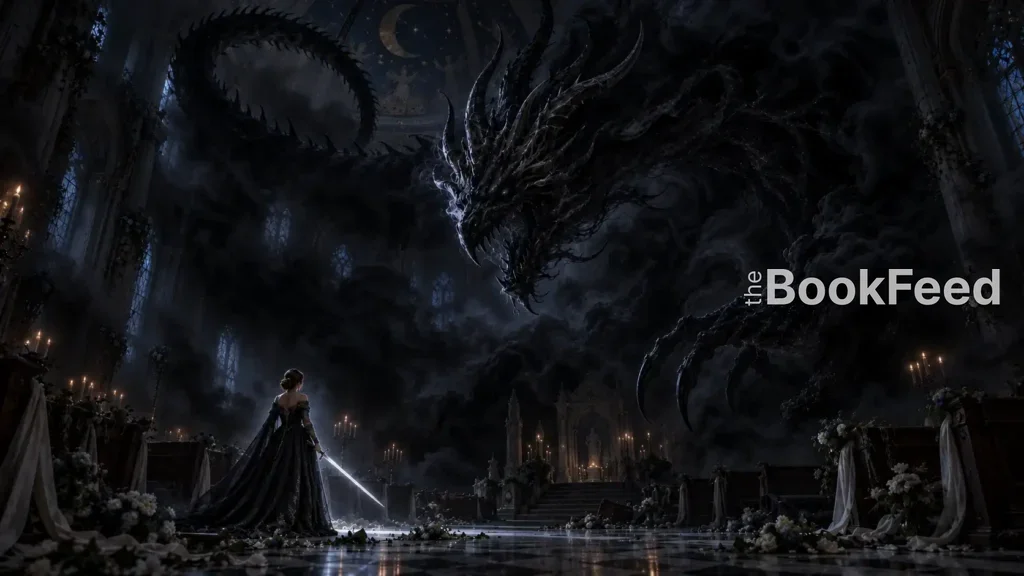
Nesta uses Ataraxia against Bryaxis, but the creature’s form is made of shadow and smoke. It escapes the temple and eventually returns to the library. There, Feyre’s determination to protect Nyx clashes with Clotho’s insistence that the library remains a sanctuary.
Lucien Discovers Elain and Azriel Together
Elain and Azriel have become physically involved despite Rhysand’s objections and Elain’s unresolved mating bond with Lucien. When Lucien discovers them naked together, the secret relationship becomes a crisis for the court.
Lucien withdraws his cooperation and leaves. His departure affects the Night Court’s political connections and access to information. Azriel must face the consequences of allowing his private life to interfere with his responsibilities.
The fallout also leads to an argument between Elain and her sisters. Elain challenges the role her family has allowed her to occupy and the assumptions they continue to make about her.
Rhysand Returns Nesta’s Weapons and Helps Her Train
After Bryaxis’s attack, Rhysand returns the Trove and magical weapons to Nesta. She asks him to teach her how to control and protect what she carries, including the use of pocket realms.
Their cooperation marks a change after weeks of distrust. Nesta gains access to both her weapons and knowledge that can help her use her abilities more effectively.
Nesta Reaches the Prison, and Elain Leaves With Mor
Amren finds Nesta preparing to try reaching the Prison again. Their conversation challenges Nesta to consider whether her future must remain tied to the Night Court.
Nesta finally winnows to the Prison with Gwydion. The sword is taken from her hand, creating the book’s central cliffhanger.
Elsewhere, Elain asks Mor to take her to Vallahan. She argues that her abilities as a Seer and her status as Made could be useful to the mission. Mor agrees, and they leave together.
A Court of Splintered Harmony Ending Explained
Why Does Nesta Return to the Prison?
Nesta returns because the Prison connects the questions she has about her power, Gwydion and her future. Her encounter with Bryce revealed a history beneath the island that reaches beyond the Night Court. The eight-pointed star gives her a personal reason to pursue it.
Her departure also develops the conflict running through her story: Nesta wants a purpose she can choose for herself. Reconciling with Cassian and accepting Rhysand’s help do not remove that need. She can rebuild those relationships while still seeking answers beyond Velaris.
What Happens to Gwydion at the End?
Gwydion is taken from Nesta when she reaches the Prison; the force responsible is not identified. That distinction matters. The ending gives us an event to explain, but leaves its cause open.
The sword’s history makes its arrival significant. Gwydion has crossed between worlds and is connected to the ancient history Nesta encountered with Bryce. Bringing it back to the Prison may have awakened a response from a being, an enchantment or the place itself.
The cliffhanger changes the direction of Nesta’s investigation. She arrives hoping to learn more while carrying a powerful weapon. Now, finding the sword may become part of finding those answers. The possibility that she must claim it for herself is explored in the theories below.
Does Nesta Become High Lady of the Dusk Court?
No formal claim or appointment makes Nesta High Lady of the Dusk Court in this ending. The theory comes from the convergence of the Prison’s lost history, Gwydion, the star and Nesta’s search for a place of her own.
Our reading is that the book positions her to uncover that history before deciding what it means for her. A future role connected to the island is plausible, but the ending leaves the nature of that role open.
Do Elain and Azriel End Up Together?
Elain and Azriel become involved, but their romantic future remains unresolved. Being discovered forces their relationship into the open without resolving Elain’s mating bond or the consequences for Azriel.
Elain’s decision to leave with Mor matters because her final move gives her a direction beyond the relationship. Vallahan offers work, distance and the opportunity to use abilities that have often left her on the edge of the action.
Azriel’s shadows complicate the picture further. Their avoidance of Elain affects the information available to him, while their different response to Gwyn remains suggestive. We read that contrast as a question about how his power works as well as a romantic clue.
Why Does Lucien’s Departure Matter?
Lucien’s departure turns a private betrayal into a political loss. The Night Court has relied on his cooperation and connections while leaving his personal situation unresolved. When he walks away, those arrangements can no longer be taken for granted.
This is one of the clearest examples of the book’s central problem: damaged relationships are affecting the court’s ability to respond to an external threat. Lucien has his own loyalties and choices, and the ending forces the Night Court to reckon with that independence.
Is Koschei Defeated?
No. Koschei remains a threat, and the conflict involving the continental kingdoms is still developing. The revelation connecting his captives to the bloodline of the warrior who bound him gives those women a potentially important place in the history of his imprisonment.
The ending leaves the court facing that threat with weakened relationships and uncertain alliances. For more background on his imprisonment and influence, see our Koschei guide.
A Court of Splintered Harmony Theories
The ending leaves several deliberate gaps. These are our interpretations of the clues, with the strongest alternatives considered alongside them.
Theory 1: Nesta Must Find and Claim Gwydion
What if losing Gwydion is the beginning of Nesta’s claiming trial? Bryce gave her the sword, but receiving it and establishing her own relationship with it may be separate steps.
The obvious parallel is Ruhn finding the Starsword in the caves beneath Avallen. Nesta now brings that same weapon to another ancient place connected to its history and immediately loses it. A search through the Prison could force her to learn why the sword has come to her.
That would make the cliffhanger particularly effective for Nesta’s story. She has spent the book questioning her purpose; recovering Gwydion could require a choice that begins to define it.
Our take: This is a strong narrative parallel, especially if the Prison responds to Nesta’s decisions. The main alternative is that an independent being has taken the sword for its own purposes, making its disappearance a theft rather than a test.
Theory 2: The Final Amren Scene Could Involve Aidas
The Amren theory asks whether Nesta’s final conversation involves an impersonation. Fan discussion has focused on “Miss Quinlan”, a form of address associated with Aidas, and the possibility that someone with knowledge of Bryce’s world is steering Nesta toward the Prison.
The most interesting part of this theory is the destination. If Aidas were directing the conversation, encouraging Nesta to bring Gwydion would place a particular person and weapon together at a site connected to the ancient crossover history.
Our take: The wording makes the scene worth revisiting, but the speaker’s intentions are the stronger mystery. Amren herself could have reasons to send Nesta there. The theory needs evidence of an impersonation beyond a familiar form of address; its most useful question is why Gwydion needs to be at the Prison now.
Theory 3: Clotho’s Ribbon Could Be Stygian Spider Silk
Throne of Glass spoilers in this section.
Clotho’s ribbon stands out because the description gives it several unusual qualities at once. It is braided, silvery, delicate as frost and almost weightless. Most strikingly, Nesta senses something almost alive about it, despite feeling no great surge of magic.
Clotho also distinguishes this gift from an ordinary ceremonial thread. It was made specifically for Nyx, and she describes it as something unique that may never be made again. Its intended purpose is to bind him to his parents and to the Mother.
Those details explain the comparison with Stygian spider silk. In Throne of Glass, the spiders connect extraordinary silk with bargains involving years of life. A fine thread that appears almost alive naturally invites questions about its material and the cost of making it.
There is also a possible thematic echo in Clotho’s name: in Greek mythology, Clotho is the Fate who spins the thread of life. That makes a unique thread given at a child’s naming ceremony an especially evocative choice.
Our take: The ribbon’s uniqueness and almost living quality are the strongest clues. Its ceremonial purpose also supports a simpler reading: Clotho has made an extraordinary gift out of gratitude and love. We would keep the material theory separate from the much larger claim that Clotho herself is a spider or that the gift harms Nyx.
Theory 4: Koschei Is Amplifying the Inner Circle’s Divisions
Could Koschei be helping create the “splintered harmony” that weakens the Night Court? He benefits from an extraordinary concentration of internal damage: Nesta’s isolation, Azriel’s compromised judgment, Lucien’s departure and Feyre’s struggle to protect both her family and her alliances.
Koschei works through influence and other people’s ambitions. Encouraging distrust could therefore serve him as effectively as a direct attack. A court occupied with its own arguments has less attention to spare for the continent.
The strongest version of this theory is that he amplifies existing weaknesses. Nesta and Cassian already disagree. Elain and Azriel already want each other. Lucien already has reasons to feel alienated. Koschei would only need to exploit the right vulnerability at the right moment.
Our take: Amplification is more convincing than explaining every conflict as magical control. The relationships have enough history to account for genuine disagreements. A link between particular incidents and Koschei’s agents would be the evidence that turns a persuasive pattern into a stronger explanation.
Theory 5: The Presence Beneath the Sea Belongs to the Prison’s Larger Mystery
Nesta’s recognition of the underwater presence suggests a connection to the kind of magic she has encountered in Made objects. Its location during her attempted journey to the Prison makes it tempting to connect the two mysteries.
If the presence and Gwydion’s disappearance are related, Nesta may have encountered part of a larger magical system before reaching the island. A concealed object, an ancient power or a connection to the island’s lost history could explain why this moment interrupts her journey.
Our take: The recognition is more useful than the location alone. Nesta’s response tells us to pay attention to the presence’s magical nature. It could still be a separate discovery, so we would watch for the same sensation returning around the Prison or Gwydion.
What Does “Splintered Harmony” Mean?
The title describes a family and court whose members can no longer rely on shared trust. They still love one another, but their competing needs and decisions are disrupting the cooperation their political position requires.
The musical language also runs through the story: Gwyn’s singing, the Song of Returning and the idea of different voices joining together. Clotho remains in the library because a lost sister might hear that song and come home. Against the court’s fractures, that offers another model of belonging: making room for someone to return.
For us, that contrast makes the title more interesting than a description of arguments. The larger story can ask what it takes to restore harmony when the people involved have changed—and whether the old arrangement is still the one they want.
Do You Need to Read Crescent City Before A Court of Splintered Harmony?
You can follow ACOSH without reading Crescent City, but it reveals major crossover developments from House of Flame and Shadow. The essential background is that Nesta lent Bryce the Mask and received Gwydion, decisions that directly shape this book.
Reading Bryce’s story first gives the disagreement its full context. Nesta helped someone facing a catastrophe in another world; the Night Court is dealing with the risk she took on behalf of theirs.
If you want to experience the crossover without advance spoilers, read through House of Flame and Shadow first. If you want to continue ACOTAR now, our ACOTAR recap includes a separately marked crossover section.
The Biggest Questions for the Next Movement
- Gwydion: Who took the sword, and what will recovering it require of Nesta?
- The Prison: How does its lost history connect to Nesta’s star and the presence beneath the sea?
- Elain: What can her abilities reveal in Vallahan?
- Lucien: Where will his loyalties and connections lead him after leaving?
- Koschei: Is he taking advantage of the court’s divisions, or actively deepening them?
Which clue do you think will matter most: Clotho’s ribbon, Amren’s instructions, the presence beneath the sea or Gwydion’s disappearance? Share your theory in the comments.


No comments