

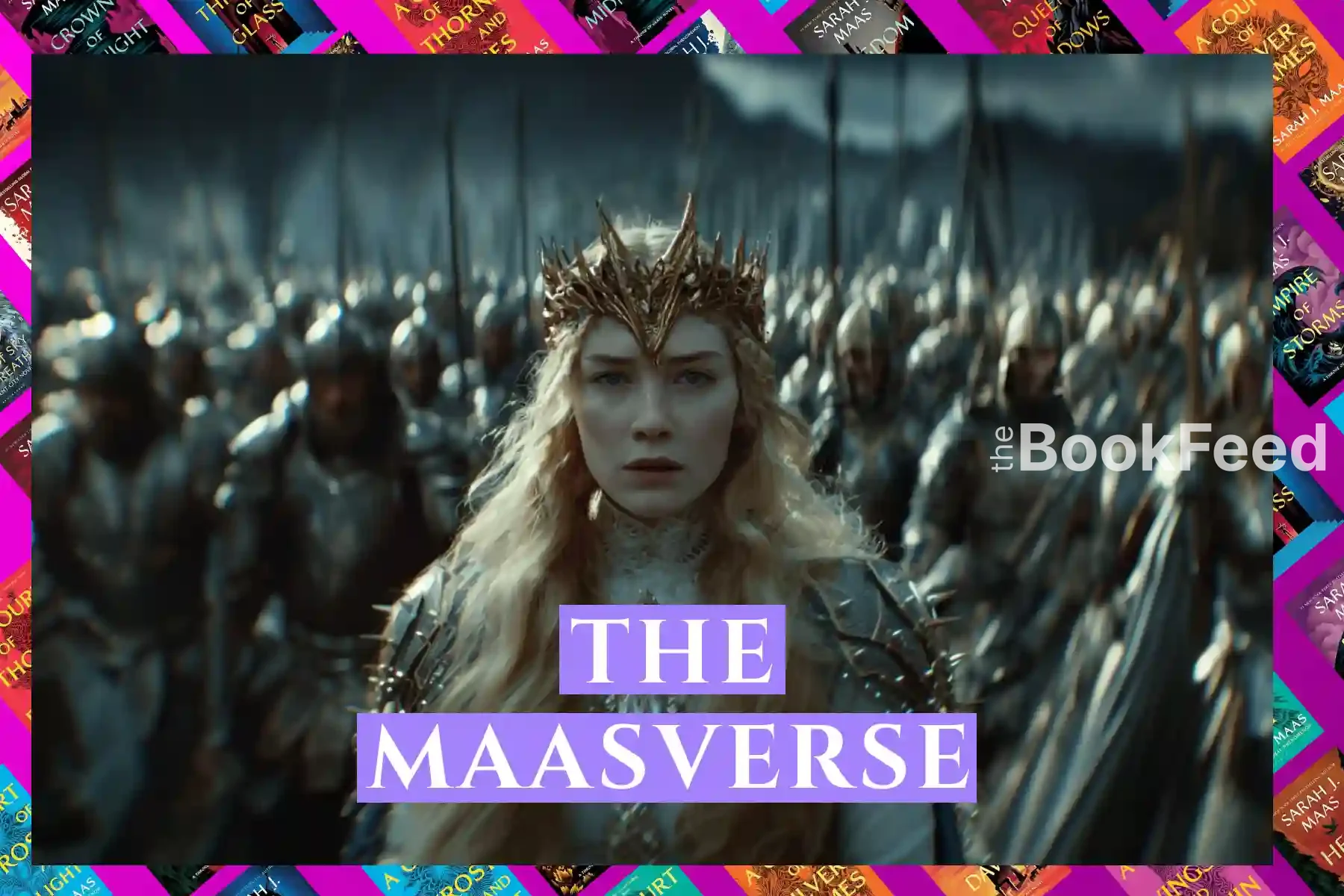
If you’ve tried to understand how ACOTAR and Crescent City connect, you’ve probably noticed how confusing it can get. The story is spread across different books, timelines, and characters, and a lot of the most important information is only revealed in pieces.
This guide brings everything together. It explains who the Daglan were, how they became the Asteri, and what actually happened long before the events of ACOTAR—in a way that’s easy to follow.
Contents
The Next ACOTAR Books
Sarah J. Maas returns to Prythian with two new books in the Valkyrie Cycle.
As an Amazon Associate, we earn from qualifying purchases. Thanks for supporting our work!
The World Before ACOTAR
Long before the courts of Prythian existed in their current form, the High Fae were not the ones in power.
For five thousand years, they lived under the rule of the Daglan, ancient beings who controlled the world through a system that was designed to look stable, but was built entirely on control. The Fae ruled over the land and over humans, but that authority was only an illusion. Above them stood the Daglan, who demanded obedience and, more importantly, a constant supply of magic.
This is where the Tithe originally comes from. Once a year, the Fae were forced to give up part of their power. It wasn’t symbolic, and it wasn’t optional. Their magic was taken in a way that both sustained the Daglan and ensured that the Fae would never become strong enough to challenge them.
Over time, the Daglan grew confident in that system. They had ruled for so long that they no longer saw the possibility of being overthrown. That overconfidence is what allowed something to grow unnoticed behind them.
Theia and the Fall of the Daglan
The rebellion that ended the Daglan’s rule did not begin with armies. It began with knowledge. Theia, who had been forced to serve one of the Daglan for years, used that time to observe them closely. She learned how they used their power and, more importantly, how they misused it. The most important of these tools was what would later be called the Dread Trove: the Mask, the Harp, the Crown, and the Horn.
The Daglan rarely used the Trove effectively because they were constantly competing with each other for control over it. That internal conflict created an opening, and Theia recognized it. Together with Fionn, whom she had loved in secret for years, she began to plan a rebellion that would rely not on strength alone, but on turning the Daglan’s own power against them. Even the Cauldron, which the Daglan had captured and twisted from a force of creation into something far more destructive, became part of that plan.
When the rebellion finally came, it succeeded in a way none before it had. The Daglan were defeated, not by a stronger force, but by their own weapons used against them.
A World Freed — and a Power That Remained
After the Daglan fell, the world changed almost immediately. Without the Tithe, magic began to return to the Fae and to the land itself. Power was no longer being drained away, and for the first time in thousands of years, the Fae were able to exist without being controlled.
Fionn became High King, and Theia ruled beside him. But she also claimed something that had once belonged to her former masters: the island where she had been enslaved.
That island, hidden in mist and deeply tied to dusk and twilight, became her personal domain. It was not just a territory, but a place that responded to her magic, as if the land itself had a will that had been waiting to awaken again. This is the same place that will later become known as the Prison in ACOTAR, although by that point, its true history has been almost entirely forgotten.
For a time, the world was stable. There was no war, and the Fae had regained their strength. But that stability did not mean that everything had truly been resolved.
Theia’s Ambition and the Shift in Power
As the years passed, the balance between Theia and Fionn began to shift. When Fionn grew older, he chose their daughter Helena as his heir instead of Theia. That decision created a fracture that was not immediately visible, but deeply important. It placed the future of the world in the hands of the next generation, while Theia herself was still at the height of her power.
Not long after, Fionn died during a hunt, under circumstances that were never fully explained. What is clear is what followed: Theia returned with his weapons, took control of the Dread Trove, and ruled alone.
What followed was not a collapse, but a consolidation of power. Theia returned with his weapons, took control of the Dread Trove, and ruled alone. Her reign was not chaotic, and there was no open war, but it was clear that her authority was absolute. Over time, that power began to change the direction of her thinking.
Theia had not forgotten the Daglan. She remembered what they had said about other worlds, other places they had conquered. What had once been a warning slowly became something else: an opportunity.
The Opening of the Portal
The idea of other worlds became central to Theia’s vision of the future. With two daughters and only one throne to inherit, she began to look beyond her own world. The Horn and the Harp, both part of the Dread Trove, made it possible to open a doorway between worlds. It was dangerous, and many of the Fae opposed the idea, unwilling to repeat the same pattern of conquest they had just escaped. But not all of them refused.
With the support of Pelias and those who believed in expanding their power, Theia chose a target: a world that had once been noted by the Daglan themselves. She was told it was empty, a place of potential rather than resistance.
What she did not know was that this had been set in motion long before she ever made the decision. Pelias had already been in contact with the Daglan, and they had been waiting—patiently—for exactly this moment.
Midgard and the Return of the Daglan
When the Fae arrived in Midgard, nothing immediately seemed wrong. They were greeted by beings who appeared to be Fae, who claimed to have been separated from their kind long ago. The explanation was simple and convincing enough that Theia accepted it. The new world seemed full of promise, and her people began to settle there.
At the same time, the Daglan—now calling themselves the Asteri—were watching. They allowed the Fae to grow comfortable. They allowed more of them to cross into Midgard, ensuring that their original world would be left more vulnerable. Only once that process was complete did they begin to tighten their control. By then, it was too late to undo what had been done.
How the Asteri Control Magic
The system that Asteri built in Midgard mirrors what the Daglan had once done in Prythian, but it is even more difficult to escape. Instead of relying on a yearly Tithe, they created something permanent. The water itself was altered, infected with parasites that entered the bodies of anyone who consumed it. From that moment on, magic was no longer entirely their own.
The Asteri introduced a ritual that appeared necessary, even beneficial. It allowed magic to be released and controlled, framed as a way to maintain balance. In reality, it served a different purpose: it allowed the Asteri to harvest that power directly. Those who refused the process did not remain independent. The parasites ensured that they would slowly weaken and die. There was no clean way out of the system. By the time the truth was understood, it had already taken hold.
The War Against the Asteri
Once Theia learned what the Asteri truly were, she attempted to do what she had done once before. She gathered allies, including forces from Hel, and tried to build a resistance strong enough to overthrow them. For a time, it seemed possible that history might repeat itself. But the situation had changed. The Asteri were prepared for rebellion in a way the Daglan had not been. Pelias, who had once stood beside Theia, now led their forces against her. The war was not a single turning point, but a slow and brutal loss. By the time the final attack came, Theia’s forces were already weakened.
The End of Theia’s Story
Knowing that she could not win, Theia made a different choice. Instead of trying to hold the line, she chose to ensure that the door between worlds would be closed. She gave the Horn and the Harp to her daughters and told them to escape, to return to their original world and seal the passage behind them.
What followed was not a clean escape. Helena stayed behind to buy time, while Silene made it to the portal. As the doorway closed, Theia remained behind, fighting Pelias. She did not survive. Helena was captured, and her fate would shape the future of Midgard. After Theia’s death, Pelias forced her into marriage and used her to legitimize his rule, establishing himself as a Starborn Prince. Through her, the bloodline continued—eventually leading to Bryce Quinlan and Ruhn Danaan.
Silene, on the other hand, returned to Prythian carrying the full knowledge of what had happened.
The Bloodlines That Connect the Worlds
This is where the story becomes directly relevant to both ACOTAR and Crescent City.
Silene chose to hide the truth. She believed that the only way to protect her world was to ensure that no one could follow her back to Midgard. The history of the Fae who had left was reduced to something that would eventually fade into legend. But she did not erase it completely. She preserved that knowledge within her own bloodline, passing it down in secret through what would become the Night Court. At the same time, Helena’s line continued in Midgard, eventually leading to the Starborn bloodline of Bryce Quinlan and Ruhn Danaan.
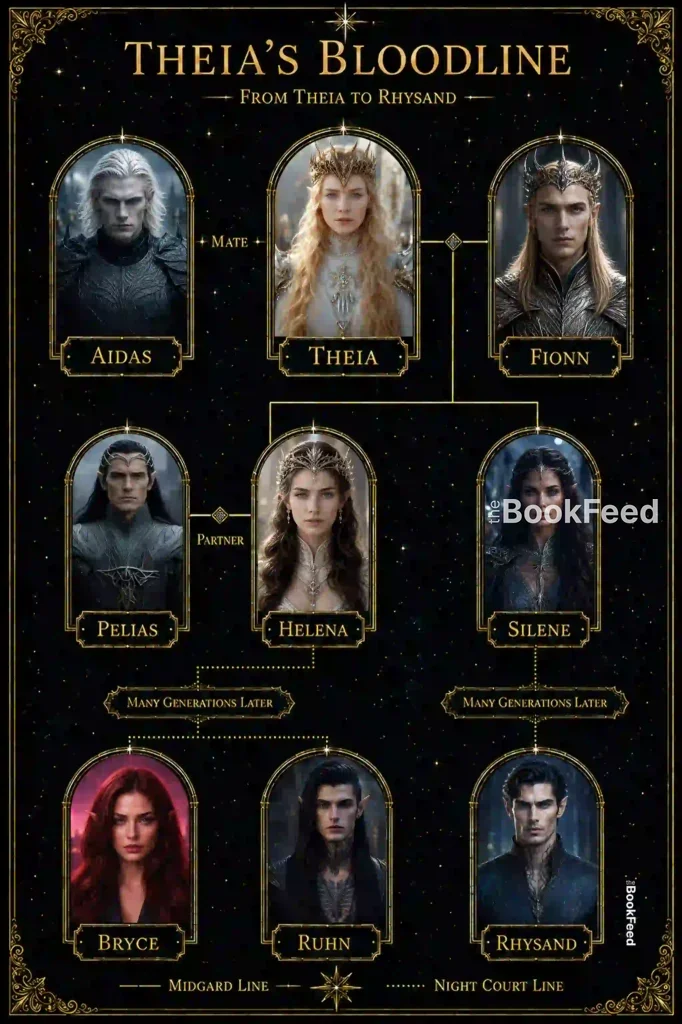
If you simplify it, the connection looks like this:
Theia had two daughters.
Helena remained in Midgard, and her descendants carry the Starborn power.
Silene returned to Prythian, and her descendants became part of the Night Court.
This is the point where the two worlds split—and the reason they are able to reconnect later.

No comments