













ACOTAR Bonus Chapters – Complete Book Guide
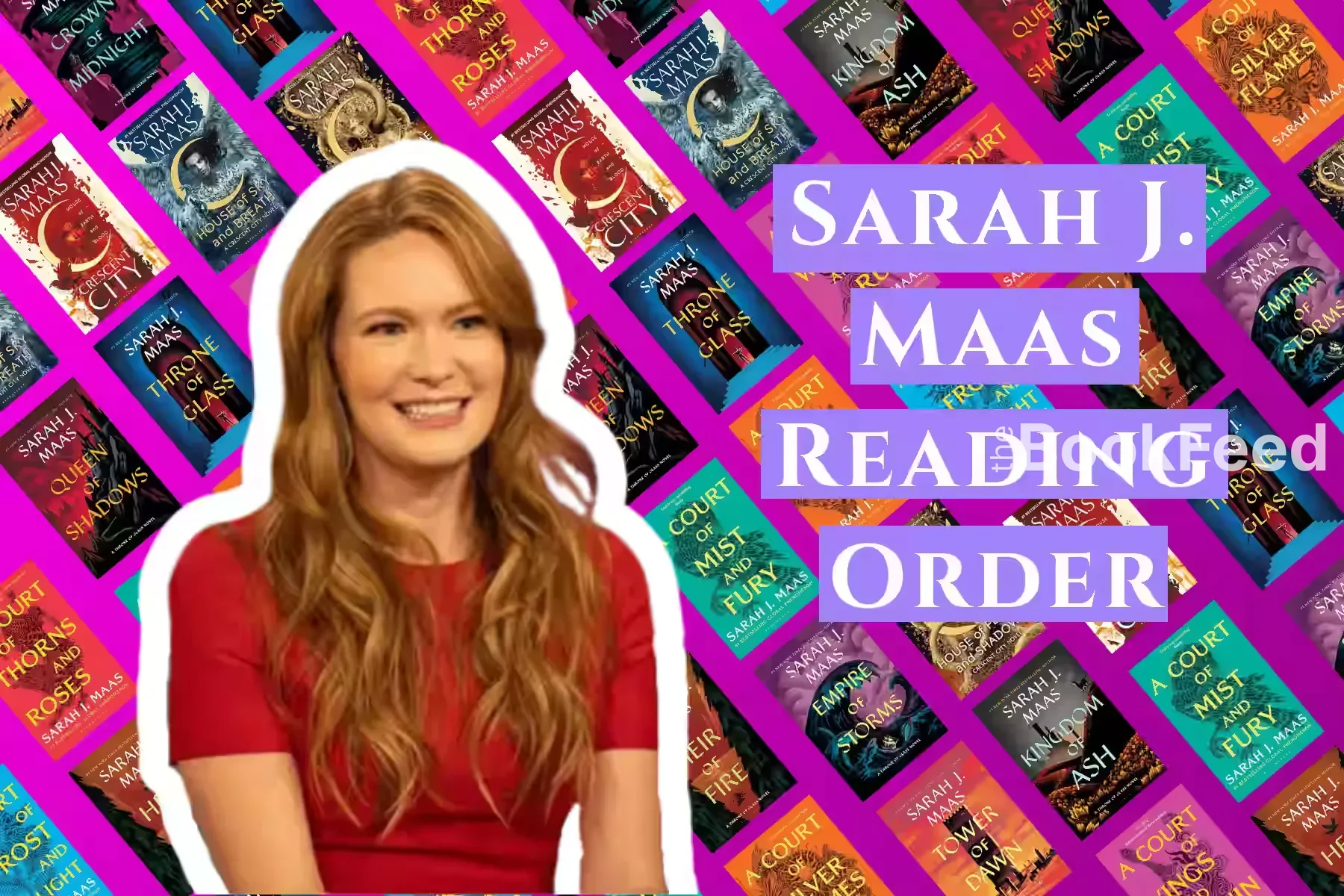
This guide explains the best Sarah J. Maas reading order, publication order, and how ACOTAR, Throne of Glass, and Crescent City connect—without unnecessary spoilers.
Contents
Why This Order Works
- Begins with the most accessible romantasy (ACOTAR)
- Moves into Maas’s largest, most intricate world (TOG)
- Ends with the series that ties universes together (Crescent City)
- Places The Assassin’s Blade at the strongest emotional point
- Builds your understanding of the Maasverse gradually and naturally
This path ensures maximum emotional payoff, minimal confusion, and the best overall reading flow.
What is the best reading order for Sarah J. Maas?
Recommended book order:
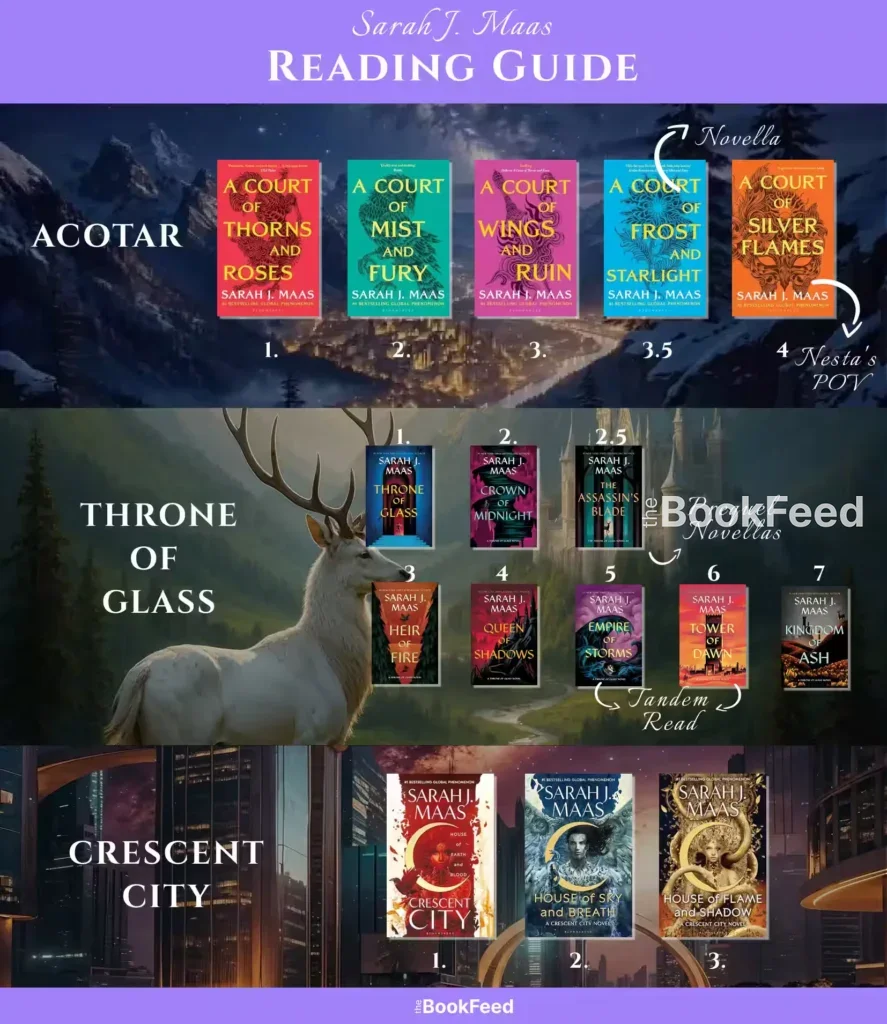
ACOTAR → Throne of Glass → Crescent City
If you want the smoothest reading experience across all three Sarah J. Maas series, we recommend the following book order. It is designed to ease readers into the Maasverse by gradually increasing world-building complexity, emotional depth, and narrative scope. This order also respects how romance develops across the series while preserving the impact of major reveals and cross-world connections as they appear later. Reading the series this way allows each story to stand on its own, while still building toward the larger universe Maas eventually weaves together.
1. A Court of Thorns and Roses Series — Start Here
ACOTAR is the easiest entry point into Maas’s writing: immersive, romantasy-forward, emotionally intense, and perfect for readers who want a blend of fae courts, slow-burn romance, and high-stakes fantasy. Beginning here gives you a strong foundation in Maas’s writing style and worldbuilding before shifting into her more intricate series.
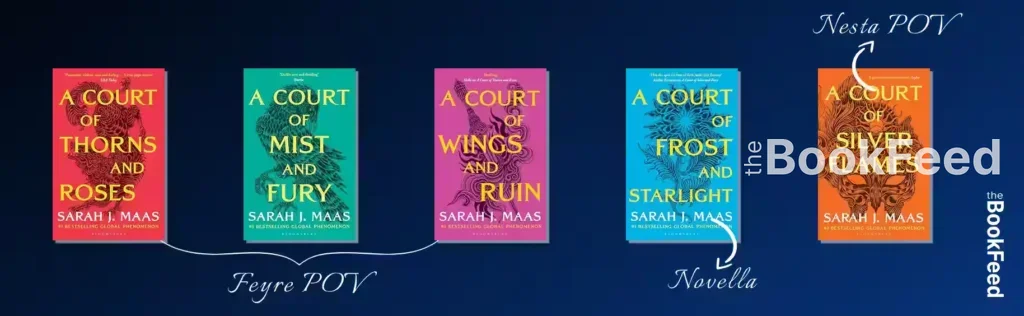
ACOTAR Reading Order:
- A Court of Thorns and Roses
- A Court of Mist and Fury
- A Court of Wings and Ruin
- A Court of Frost and Starlight (novella)
- A Court of Silver Flames
2. Throne of Glass Series — Read Second
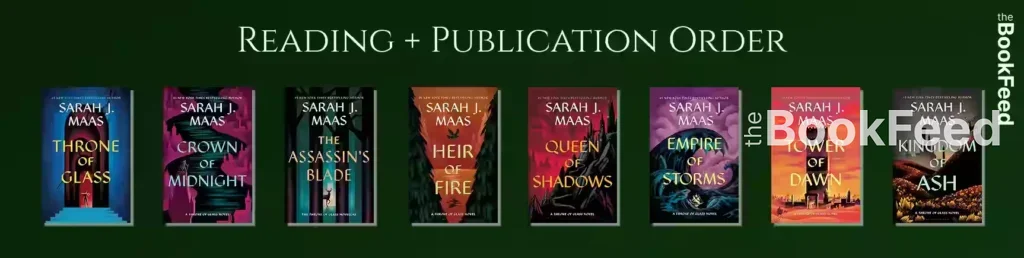
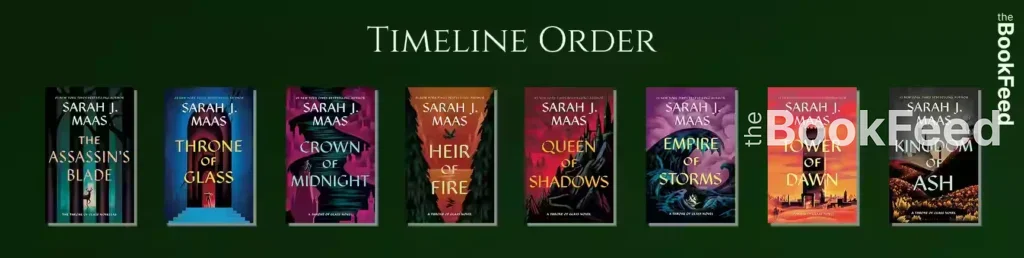
Throne of Glass is Maas’s most expansive series, with a larger cast, deeper lore, and a much bigger fantasy scope. Reading it after ACOTAR allows you to appreciate her growth as an author and makes the emotional arcs hit harder.
Official Bloomsbury Recommendation:
Read in publication order, which means reading The Assassin’s Blade after Crown of Midnight. The novellas won’t spoil anything if read first, but they are more impactful when placed between Crown of Midnight and Heir of Fire.
Throne of Glass Reading Order (Publication Order):
- Throne of Glass
- Crown of Midnight
- The Assassin’s Blade (novellas — recommended here)
- Heir of Fire
- Queen of Shadows
- Empire of Storms
- Tower of Dawn
- Kingdom of Ash
3. Crescent City Series — Read Last

Crescent City is Maas’s most mature, urban-fantasy-meets-high-fantasy world, and it contains major cross-series implications. Reading it last ensures you catch the references, understand the cameos, and experience the crossover moments with their full emotional weight.
Crescent City Reading Order (Publication Order):
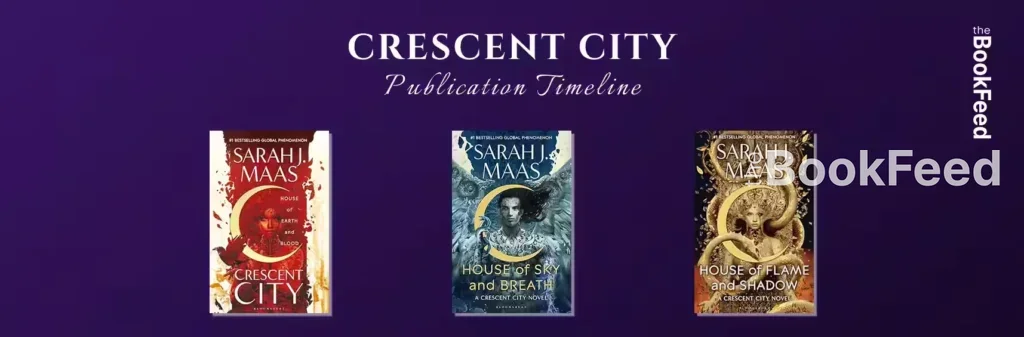
- House of Earth and Blood
- House of Sky and Breath
- House of Flame and Shadow
Sarah J. Maas Books in Publication Order
A complete list of A Court of Thorns and Roses (ACOTAR), Throne of Glass (TOG), and Crescent City (CC) by publication date—useful if you prefer to read in release order or want a visual checklist.
Why the Sarah J. Maas Book Order Can Feel Overwhelming
Sarah J. Maas has created some of the most beloved romantasy and fantasy worlds of our time. Lush, emotional, sweeping universes filled with fae courts, magic systems, political intrigue, found families, and unforgettable slow-burn romances. But with three major series, multiple timelines, and a few surprising cross-world connections, figuring out the best reading order isn’t always straightforward.
Do you start with A Court of Thorns and Roses or Throne of Glass? Should you read The Assassin’s Blade first or wait until later? And where does Crescent City fit, especially now that the Maasverse has officially intertwined?
This guide is designed to make everything clear. Whether you’re brand new to her books or returning for a re-read, the recommended reading path will help you move through her worlds in a way that feels intuitive, emotionally satisfying, and easy to follow.
You’ll find a quick reading order for beginners, deeper explanations for each series, spoiler notes, and a dedicated section on how the universes connect, plus a cinematic video addition to bring the Maasverse to life.
Should I read ACOTAR or Throne of Glass first?
For most readers, A Court of Thorns and Roses is the better series to start with. It offers a more accessible entry point into Sarah J. Maas’s writing, with a smaller cast, a clearer romantic throughline, and a world that unfolds gradually rather than all at once. ACOTAR’s romantasy focus, fae courts, emotional character arcs, and slow-burn romance, makes it especially welcoming for readers who are new to Maas or to fantasy-heavy series.
Throne of Glass, while immensely rewarding, is a larger and more complex epic fantasy. It features a broader cast, multiple timelines, shifting points of view, and deeper layers of lore that build over several books. Reading it after ACOTAR allows readers to ease into Maas’s storytelling style before tackling her most expansive world. Many readers also find that experiencing ACOTAR first enhances their appreciation of Throne of Glass’s emotional depth, character growth, and long-form storytelling.That said, readers who prefer classic epic fantasy over romantasy may choose to start with Throne of Glass instead. Both series stand on their own—but for the smoothest introduction to the Maasverse, starting with ACOTAR and reading Throne of Glass second is the most widely recommended book order.
What is the ACOTAR series about?
The ACOTAR series is the perfect entry point into Sarah J. Maas’s storytelling, especially for romantasy-first readers. Blending fae mythology, political drama, magic systems, and rich emotional arcs, ACOTAR is both accessible and addictive. It begins as a Beauty and the Beast–inspired retelling, but quickly expands into a tale of love, trauma healing, empowerment, and complex court dynamics. This series introduces many of the tropes and emotional beats that Maas is known for—slow-burn tension, found family, morally gray characters, and deeply romantic plotlines that intensify with each book.
As the series progresses, the world opens dramatically. Readers move from the isolated Spring Court into the vibrant Night Court and beyond, gaining a deeper understanding of Prythian’s geography, magic, political alliances, and history. Maas layers her storytelling in a way that feels inviting rather than overwhelming, perfect for new readers. The narrative also becomes increasingly mature, making the leap from new-adult fantasy toward full romantasy with emotional and sensual depth.
One of ACOTAR’s greatest strengths is its character work. Feyre’s journey, from survivor to artist to High Lady, has become iconic within the genre. Rhysand’s arc, the Inner Circle’s dynamics, and the shifting relationships between courts create a sense of intimacy and belonging that readers latch onto quickly. The tone is lush and atmospheric yet fast-paced, and Maas’s writing evolves significantly from book one to book five (A Court of Silver Flames), which explores themes of mental health and healing through a powerful, character-driven arc.
For romantasy-specific audiences, A Court of Thorns and Roses resonates because it balances a high-stakes fantasy plot with emotional vulnerability and relationship-centered storytelling. It’s the series that pulls readers into the wider Maasverse, and sets the tone for the deeper, more complex journeys ahead.
What is the Throne of Glass series about?
Throne of Glass is Sarah J. Maas’s most ambitious and expansive work, a sweeping epic fantasy that grows in scope, tone, and emotional depth with every book. Beginning as a story about a notorious assassin forced into a deadly competition, the series quickly evolves into a multi-POV, continent-spanning saga filled with magic, rebellion, ancient prophecies, and fierce character transformations. It’s widely considered her most complex and complete world, with intricate lore, a massive cast, and some of the strongest character arcs in modern YA/NA fantasy.
TOG’s tonal progression is one of its defining features. The opening books feel lighter, almost whimsical, with palace intrigue, flirtation, and mystery at the forefront. But with Heir of Fire—a pivotal book for both the series and Maas’s growth as an author—the narrative deepens dramatically. Themes of identity, trauma, resilience, found family, and sacrifice take center stage. Characters who once felt simple reveal layers of vulnerability and strength, and new storylines emerge that connect across continents.
The emotional payoff of Throne of Glass is immense. Each book builds on the last, and Maas masterfully braids together multiple timelines and character POVs. By the time the series reaches Empire of Storms, stakes are global, friendships are battle-forged, and romances are some of the most beloved in the genre. Kingdom of Ash delivers a finale that is sweeping, cathartic, and deeply satisfying.
Because it’s such a large and evolving series, reading order matters, especially regarding The Assassin’s Blade. Publisher guidance suggests reading the novellas after Crown of Midnight, where their emotional resonance is strongest. This placement gives key characters more weight and context before the shift that occurs in Heir of Fire. However, new readers who prefer chronological order can start with the novellas without fear of spoilers.
For readers who love immersive worldbuilding, broad ensemble casts, slow-burn romance, and epic fantasy scale, Throne of Glass is a masterpiece and a perfect second series after ACOTAR, especially for romantasy readers transitioning into higher fantasy.
What is the Crescent City series about?
Crescent City is Sarah J. Maas’s boldest and most mature series, blending urban fantasy, high fantasy, romance, and mystery into a single, richly layered world. Set in Lunathion, a bustling, modern, magic-infused city, the series combines crime investigation, political tension, ancient magic, and sweeping romantic tension. It introduces technology, modern culture, and supernatural species coexisting in a society dense with history, inequality, and buried secrets.
The tone of Crescent City is distinctly adult. Themes of grief, healing, belonging, loyalty, and identity run deep, and the emotional stakes are matched by an intricately constructed world. Maas weaves together angels, fae, shifters, necromancers, mer, demons, and more into a society where power structures mirror real-world complexities. The books are dense but extremely rewarding, especially for readers who enjoy slow reveals and layered mysteries.
Bryce Quinlan—sharp, bold, grieving, and resilient—is one of Maas’s most nuanced protagonists. Her dynamic with Hunt Athalar, the morally gray fallen angel tasked with partnering with her, is charged with chemistry, tension, and vulnerability. Their romance unfolds alongside a broader conspiracy that spans ancient wars, hidden histories, and multiverse implications.
With House of Sky and Breath and House of Flame and Shadow, the series elevates itself into the center of the Maasverse. For readers who have finished A Court of Thorns and Roses and Throne of Glass, the cross-world elements land with immense emotional impact. Reading Crescent City last ensures that readers recognize the connections, cameos, and lore references that tie all three universes together.
Crescent City is ideal for readers who want high-stakes action woven with romance, mythology, and mystery, and who enjoy deep dives into complex worlds. It is, in many ways, the culmination of Maas’s growth as a storyteller.
How the Maasverse Universes Connect
(Spoiler Warning: This section contains medium-level spoilers for ACOTAR, Throne of Glass, and Crescent City.)
One of the most fascinating—and now most discussed—elements of Sarah J. Maas’s work is the fact that her three major series exist within a shared multiverse. While each storyline functions independently, threads of lore, magic, mythology, and even characters weave these worlds together in subtle and eventually unmistakable ways. Many readers finish Crescent City and immediately rethink everything they’ve read before, noticing small details in ACOTAR and Throne of Glass that hint at a much larger cosmic design, and realizing how much the book order can shape that discovery.
Maas builds her multiverse slowly. It begins with mirrored themes, similar magical structures, and recurring symbolic imagery that sharp-eyed readers pick up on long before explicit connections are revealed. Over time, these parallels evolve into something concrete, bridging worlds, exposing ancient histories, and suggesting that the characters and events of each series are part of a grander, interconnected tapestry.
Because the Maasverse connects through magic, portals, and deep lore rather than simple crossovers, choosing the best reading order greatly enhances the experience. Reading ACOTAR first provides a foundation in Maas’s fae-based magic systems; reading Throne of Glass next deepens your understanding of ancient powers and cosmic history; and reading Crescent City last brings those threads together in a spectacular and emotionally resonant way.
Are Sarah J. Maas’s series set in the same universe?
Each series exists in a distinct world with its own rules, species, geography, and magic systems, and the differences between them become especially clear when experienced in reading order. Throne of Glass takes place in a classic high-fantasy continent shaped by lost magic and ancient entities; ACOTAR unfolds in a transformed, fae-dominated world where courts hold immense political power; and Crescent City is set in a modern, magical metropolis blending fantasy, technology, and celestial beings.
Yet beneath these contrasts lie shared themes and universal forces—suggesting that these worlds may have sprung from the same cosmic origin or are connected through dimensional pathways. When read in sequence, subtle references to “other worlds,” “distant realms,” and “threads between worlds” stand out more clearly, hinting at an overarching multiverse long before it is made explicit.
When the Connections Become Explicit
Without revealing major plot specifics, readers can expect the following:
- Characters in Crescent City interact with individuals from other series.
- Magic systems that once seemed separate begin to overlap.
- Lore references from ACOTAR and TOG suddenly gain new meaning.
- Ancient histories from earlier series reappear with expanded context.
This is why reading Crescent City last is so crucial—it delivers the emotional and narrative payoff for all the hints scattered throughout her earlier works.
Why These Connections Matter
Understanding the multiverse isn’t necessary to enjoy any individual series, but it does enhance the experience, especially when approached with a thoughtful book order. For longtime fans, this perspective opens the door to endless theorizing, richer re-reads, and a deeper appreciation of Maas’s long-term storytelling. And for new readers, it adds an extra layer of excitement, knowing that the order in which the stories are read can subtly shape how connections and revelations are discovered over time.
The Complete Detailed Sarah J. Maas Best Reading Order
This is the heart of the guide—the full, reading-order breakdown for all Sarah J. Maas books, reflecting our recommended path:
- Start with ACOTAR
- Then read Throne of Glass
- End with Crescent City
Each book includes a detailed, spoiler-conscious summary that explains its role, tone, pacing, and emotional impact within the series.
A Court of Thorns and Roses — Full Reading Order
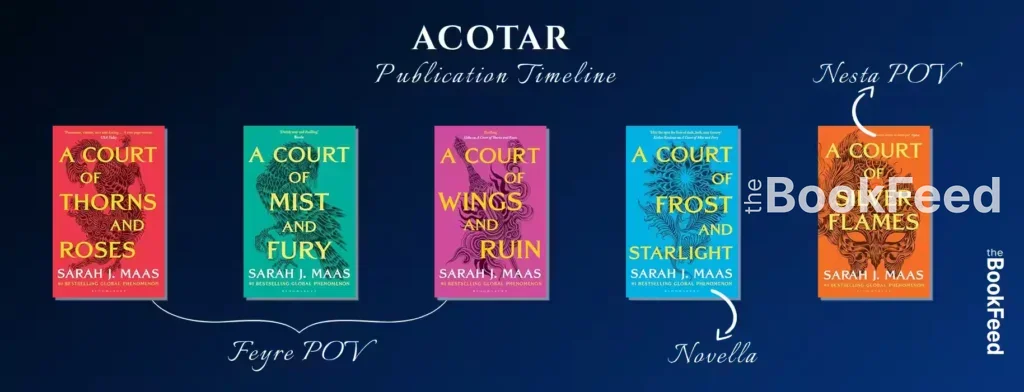
1. A Court of Thorns and Roses
The first book introduces Feyre Archeron, a mortal huntress whose life changes after she kills a faerie wolf in the woods. As punishment, she’s taken across the wall into the fae realm and forced to live in the Spring Court under the watch of Tamlin. What begins as a Beauty and the Beast–inspired setup slowly unfolds into a darker, more seductive world filled with ancient curses, dangerous courts, and powerful enemies. ACOTAR establishes the foundations of Prythian—its politics, its magic, and its looming threats—while setting the emotional tone for the rest of the series. Readers often describe it as deceptively simple, with an ending that shifts the entire direction of the story.
2. A Court of Mist and Fury
Widely considered one of the strongest romantasy sequels of the decade, ACOMAF completely reshapes the series. Feyre—traumatized and transformed by the events of book one—must confront who she is, what she wants, and the power she now carries. Her dynamic with Rhysand shifts into sharp focus, revealing new layers of intimacy, trust, and emotional healing. This book expands Prythian dramatically, introducing the Night Court and the unforgettable Inner Circle. ACOMAF explores themes of autonomy, trauma recovery, found family, and self-worth, all while escalating political tension and romance in a beautifully paced, character-driven narrative.
3. A Court of Wings and Ruin
The third book delivers on the high-stakes buildup of the previous installment. Feyre returns to the Spring Court as a spy, weaving political intrigue and secrets into a tense opening act. The conflict between courts intensifies, alliances shift, and war looms. ACOWAR brings together the series’ most powerful players, introduces deeper world lore, and executes emotionally charged battles and turning points. This is where Feyre fully steps into her role as High Lady, and where relationships solidify under pressure. The climax reshapes Prythian’s future and sets the groundwork for the novella and spin-off stories.
4. A Court of Frost and Starlight (Novella)
A cozy, character-centered interlude, ACOFAS gives readers a breather after the emotional intensity of the first three books. Set during the Winter Solstice, it follows several characters as they navigate healing, rebuilding, and redefining their lives after the war. It’s lighter in plot but rich in emotional nuance, offering valuable insights into trauma recovery, friendship, and shifting relational dynamics. While optional, it provides essential bridge content before A Court of Silver Flames.
5. A Court of Silver Flames
Switching to Nesta Archeron’s perspective, ACOSF is a raw, powerful exploration of grief, anger, self-destruction, and ultimately, profound healing. Nesta’s journey through training, friendship, and vulnerability creates some of the most emotionally resonant moments in the entire series. Her tension-filled dynamic with Cassian transforms into a deeply grounded, adult romance. This book also expands the magic and mythology of Prythian, hinting at future conflicts and cosmic forces that tie into the broader Maasverse. Emotionally intense and thematically heavy, ACOSF marks the transition into Maas’s most mature storytelling.
Throne of Glass — Full Reading Order
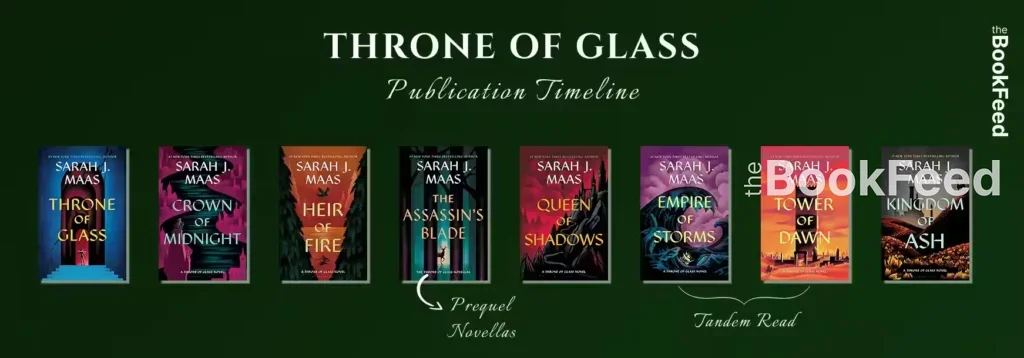
1. Throne of Glass
The series begins with Celaena Sardothien, the kingdom’s most notorious assassin, pulled from a prison camp to compete in a dangerous tournament. The tone is lighter here than in later books: glamour at the glass castle, flirtation, mysteries, and hints of magic lurking beneath the surface. The story is deceptively simple at first, laying foundational character relationships and planting early seeds of the larger conflicts. Celaena’s confidence, complexity, and fierce independence quickly define her as a standout fantasy heroine.
2. Crown of Midnight
The stakes escalate sharply as Celaena’s loyalties, secrets, and emotional walls collide with the brutal reality of the king’s rule. This book digs deeper into her past, reveals major twists, and introduces darker themes that set the stage for the series’ evolution. Relationships intensify, moral lines blur, and the plot shifts from palace intrigue to rebellion. The ending is a pivot point for the entire series.
3. The Assassin’s Blade (Read Here)
A collection of prequel novellas, The Assassin’s Blade explores Celaena’s life before the events of book one. Read here, after Crown of Midnight, the emotional impact lands with far more weight. You meet essential characters, uncover foundational motivations, and experience the heartbreak that shapes Celaena’s entire arc. Reading it now enriches Heir of Fire dramatically. The Publisher notes that it’s fine to read first—but this placement creates the strongest emotional resonance.
4. Heir of Fire
This is the book where Throne of Glass transforms. Shifting to new settings, new characters, and new lore, the story deepens into true epic fantasy. Celaena confronts her past, her power, and her identity in one of Maas’s most skillful character arcs. Introductions of Rowan, Aedion, Manon, and others add immense depth to the world. Themes of trauma, acceptance, duty, and chosen family rise to the forefront in some of the most emotional writing of the series.
5. Queen of Shadows
A triumphant and cathartic installment, Queen of Shadows brings Celaena’s reclaimed identity into full force. Old enemies return, political threads unite, and long-simmering tensions explode. This book is packed with action, emotional reunions, and major power shifts. The tone is sweeping and cinematic, marking the midpoint of the saga’s full transformation.
6. Empire of Storms
The story expands across continents as the ensemble cast faces escalating threats. Allies unite, prophecies unfold, and romantic threads intertwine with world-shaping decisions. Empire of Storms is one of the most fast-paced and climactic books in the series, ending on a devastating cliffhanger that sets the stage for the final battle.
7. Tower of Dawn
Running parallel to Empire of Storms, this novel follows Chaol’s journey to the Southern Continent. It introduces new cultures, new magic systems, and essential world lore. Themes of healing, disability, redemption, and partnership define this quieter but deeply meaningful addition. By the end, the events tie directly back into the main storyline—making it required reading before the finale.
8. Kingdom of Ash
The final book brings every character, conflict, prophecy, and relationship together in a massive, multi-POV conclusion. It’s emotional, brutal, triumphant, and deeply satisfying. Maas balances world-shaking battles with intimate character moments that honor the entire journey. This finale cements Throne of Glass as one of the great modern epic fantasies.
Crescent City – Full Reading Order
1. House of Earth and Blood
The series opens with Bryce Quinlan, a half-fae party girl with sharp wit, deep grief, and a fiercely loyal heart. After a brutal tragedy shatters her life, Bryce becomes entangled in an investigation tied to ancient magic and powerful forces within Lunathion. This book blends mystery, urban fantasy, slow-burning romance, and emotional healing. The world is rich, dense, and technical—readers often describe it as Maas’s most complex but also one of her most rewarding worlds. Bryce and Hunt’s dynamic, equal parts banter and vulnerability, anchors the emotional core of the story.
2. House of Sky and Breath
The second installment expands the political, magical, and cosmic elements introduced in book one. Secrets unravel, new alliances form, and the stakes rise across multiple plotlines. Themes of rebellion, autonomy, loyalty, and identity are woven into fast-paced action and intimate relationship development. The ending contains one of the most dramatic reveals in the Maasverse—directly connecting Crescent City to the other series.
3. House of Flame and Shadow
This book pulls together the threads of the entire Maasverse. Without spoiling specifics, it ties previous series into the core narrative in ways that are emotional, surprising, and deeply interconnected. Magic systems collide, character arcs converge, and universes overlap. Reading this book last ensures every reveal lands with maximum impact.
Frequently Asked Questions
What is the best Sarah J. Maas reading order for new readers?
For most readers—especially romantasy-first readers—the best book order is: ACOTAR → Throne of Glass → Crescent City. This progression follows the evolution of Maas’s writing style, easing you into her worldbuilding before moving into her largest epic and finally into her most complex, multiverse-centric series. Starting with ACOTAR gives you a romantic, accessible entry point. Throne of Glass then expands into a sweeping high fantasy with deeper worldbuilding. Crescent City ties everything together with explicit multiverse connections, which land best when you’re already familiar with the earlier worlds.
This path also mirrors tone: ACOTAR (romantasy / NA) → TOG (YA → NA → Epic) → CC (Adult urban + high fantasy). You’ll experience her growth as an author in real time, while enjoying the cosmic reveals in the correct emotional order.
Should I start with Throne of Glass or ACOTAR?
While Throne of Glass is technically her first published series, most modern readers prefer beginning with ACOTAR because it’s stylistically more aligned with Maas’s current voice. A Court of Thorns and Roses offers a smoother entry into her writing style and focuses heavily on romance, character arcs, and emotional growth. It’s also quicker to get into, which helps new readers acclimate before diving into the more expansive and complex Throne of Glass world.
Throne of Glass is magnificent—but it’s a commitment. Starting with ACOTAR builds trust, familiarity, and excitement, making readers much more likely to complete the entire Maasverse journey.
When should I read The Assassin’s Blade?
The Assassin’s Blade can technically be read first, but most readers and the publisher recommend reading it after Crown of Midnight.
Why? Because reading it at that point gives the novellas maximum emotional impact. The revelations about Celaena’s past hit harder when you already understand her present struggles, relationships, and internal conflicts. It becomes a powerful emotional bridge into Heir of Fire, where her character arc evolves dramatically.
If you prefer chronological order, reading The Assassin’s Blade first will not spoil the main series—but you’ll lose some of the narrative layering Maas intended.
Are the Sarah J. Maas series connected?
Yes, all three series—ACOTAR, Throne of Glass, and Crescent City—exist within a shared multiverse. Each world has its own timeline, geography, magic system, and characters, but they are linked by ancient cosmic forces, dimensional travel, similar mythological structures, and explicit crossover moments. These connections are subtle in earlier books and become much more direct in Crescent City.
However, the series still function independently. You can read ACOTAR or TOG without Crescent City, but reading CC last adds incredible emotional payoff when those connections finally appear.
Do I need to read Throne of Glass before Crescent City?
Yes. Crescent City contains major plot points and multiverse implications that reference or align with events, characters, and magic systems from Throne of Glass. While CC is technically a separate story, the crossover moments in books two and three are designed to be experienced after you’ve journeyed through TOG. Reading TOG first ensures you understand the significance of certain reveals and character appearances.
Skipping Throne of Glass diminishes the emotional impact and narrative weight of those multiverse crossovers.
Are Sarah J. Maas’s books Young Adult?
Throne of Glass begins as YA (Young Adult) but shifts toward New Adult themes as the series progresses. A Court of Thorns and Roses is firmly New Adult / Romantasy, with increasingly explicit romantic content in later books. Crescent City is Adult Fantasy, containing mature themes, graphic violence, and explicit romance. Readers should be aware that while the early TOG books are lighter, the series becomes significantly darker and more mature.
For most readers, ACOTAR and Crescent City require comfort with adult romantic content, while Throne of Glass is a gradual progression into heavier material.
How long does it take to read all of Sarah J. Maas’s books?
Reading all three series—ACOTAR, TOG, and Crescent City—usually takes 6 to 12 weeks, depending on reading speed. Throne of Glass is the longest series, totaling over 4,000 pages; Crescent City books are dense and take longer to read due to their complex worldbuilding. ACOTAR, being the easiest to start, generally takes the least time.
For a relaxed pace, many readers follow a “one book per week” schedule, extending the journey over several months.
Is Throne of Glass hard to get into?
Many readers find that Throne of Glass truly “begins” in Heir of Fire. The first two books have a lighter tone, focusing on palace intrigue and character introductions. They’re enjoyable but not as epic as the later installments. Once you reach Heir of Fire, the series transforms into sweeping, emotionally rich high fantasy with some of Maas’s best character development.
This gradual build is why we recommend reading ACOTAR first—it prepares you for the tonal shift and helps you trust the journey.
Is ACOTAR connected to Throne of Glass?
The books do not crossover directly in the early installments, but they share multiverse connections. Certain magical structures, ancient powers, and cosmic forces hint at interconnected origins. Crescent City later confirms these hints outright. While you won’t see direct character interactions early on, readers who know both series will spot echoes, parallels, and clues that take on new meaning during CC.
Is Crescent City connected to ACOTAR?
Yes—very directly. Without giving away specific spoilers, House of Sky and Breath and House of Flame and Shadow reveal significant crossover events and character appearances from ACOTAR. These moments rely on your understanding of Prythian, the courts, and the magic systems introduced in ACOTAR. Reading Crescent City last ensures the reveals feel emotional, shocking, and richly rewarding.
Is Crescent City connected to Throne of Glass?
Yes, though the connections are more subtle and symbolic until later books. Themes of portals, cosmic magic, and ancient deities introduced in Throne of Glass align closely with the metaphysical structures in Crescent City. Later installments make these parallels far more explicit. Throne of Glass also sets foundational rules about dimensional travel that Crescent City builds upon.
What book should I read after ACOTAR?
After finishing ACOTAR (including A Court of Silver Flames), the bookfeed-recommended next step is Throne of Glass. It offers a more layered and expansive fantasy experience while maintaining the character-driven storytelling that fans of ACOTAR love. The series also enriches your understanding of the Maasverse, preparing you for Crescent City’s multiverse reveals.
If you jump straight to Crescent City after ACOTAR, you’ll miss many worldbuilding threads that originate in TOG.
Will there be more ACOTAR books?
Yes. Sarah J. Maas has confirmed that the ACOTAR world will continue, with additional novels and novellas planned. The series has multiple storylines yet to be explored, particularly involving secondary characters. While no release dates are officially set at the time of writing, Crescent City’s publication timeline suggests that new ACOTAR installments are likely to follow after her ongoing projects.
Future books may deepen political tensions, explore emerging magical threats, and uncover more of the multiverse that Crescent City reveals.
Will there be more Crescent City books?
Maas has indicated that Crescent City may continue beyond the initial trilogy, depending on narrative direction and character arcs. The third book, House of Flame and Shadow, ties together many threads, but it also expands the scope of the Maasverse dramatically. There is room for future installments—though they may be spaced out to allow work on ACOTAR and other projects.
Do I need to read the novella A Court of Frost and Starlight?
You don’t need to read ACOFAS to understand the main ACOTAR storyline, but skipping it means missing important emotional transitions. It bridges the aftermath of the war in ACOWAR and sets up Nesta’s storyline in ACOSF. It also deepens the interpersonal dynamics among the Inner Circle. Think of it as a palate cleanser—light in plot, rich in character nuance.
Does Throne of Glass have romance?
Yes—Throne of Glass includes multiple romantic arcs, ranging from slow-burn to forbidden, from friends-to-lovers to deeply bonded partnerships forged through trauma and battle. The tone of the romance shifts as the series matures. Early books contain flirtation and tension, while later ones explore emotionally resonant, soul-deep relationships that are essential to the characters’ growth and the series’ thematic weight.
Readers drawn to ACOTAR’s relationship-driven storytelling will find equally compelling, though differently paced, romances in TOG.
Is Crescent City hard to read?
Crescent City is Maas’s most complex series, mainly because of its hybrid genre structure (urban fantasy + mythological epic + romantic fantasy) and its large cast of supernatural species, political factions, and magical hierarchies. The first 150–200 pages can feel dense as the world is introduced, but once the plot ignites, the pacing becomes sharp and gripping.
Readers who enjoy layered mysteries, adult characters, and slow-burning emotional and romantic development will find Crescent City deeply rewarding.
Are any of the series finished?
Throne of Glass is fully complete with a definitive ending. ACOTAR is ongoing, with future books expected. Crescent City has three books published, and while the third book concludes major arcs, it also expands the scope of the series and Maasverse, leaving room for continuation. So: one finished series, two evolving ones.
Is Throne of Glass worth reading if I like ACOTAR?
Yes. Many readers come to Maas through ACOTAR and then discover that Throne of Glass becomes their favorite series. While TOG begins with a lighter tone, it transforms into a sweeping epic with intense emotional arcs, breathtaking character development, and some of the most powerful found family dynamics in the genre. If you love ACOTAR’s intimacy and character depth, TOG delivers both—with much larger world stakes.
In what order should I reread the Maas books?
If you’re rereading after finishing all three series, you have two excellent options:
(1) Read in publication order for a nostalgic return to the original release experience.
(2) Read in multiverse order: TOG → ACOTAR → Crescent City.
This order allows you to trace the evolution of her cosmic themes and magic systems, ending with Crescent City’s multiverse reveals for maximum clarity.
Both reread orders offer new layers of insight and emotional resonance—choose based on which world you want to revisit first.
